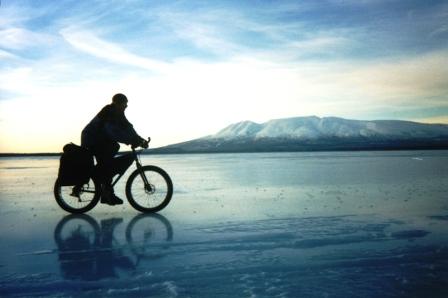
We buried our bike wheels in the snow using the frame bags for a wind block. Bill said I was out after 15 min. sleeping a full 7 hours like a Baby. Only the next morning did he tell me that sometimes during those offshore winds the sea ice breaks loose and goes out to sea. What ?
I was not disappointed he didn’t bother to tell me the night before.
There was a good chance that I would have not closed an eye otherwise.
Sleeping well in the gusting wind and getting drifted in in the blowing snow I must have been pretty tired.
But I have been told that the world could come to an end while I was sleeping in total peace.
Makes me wonder If that is a good thing or not.

I was mad at the relentless wind that had taken away the trail piece by piece. Now there was no trail where there was a trail just a few days ago. I was angry we were here now and not a few days ago.
The head game had started for me now. I didn’t care about the biting cold, I didn’t care about the wind cutting like a knife in my face every time my hood slips a little bit exposing some skin, I would fix it, I can deal with it.
But “my trail” destroyed by the furious wind, gone now, slowing a progress to a crawl.
It was like slogging through a frozen cold endless Sahara. How much further is it to Koyuk?
The 15 miles we had left to walk to Koyuk took a long time. It seemed like an eternity and like we had done 100 miles , it had taken us 29 hours from Shaktoolik to Koyuk.
I was mentally fried. This section of trail had done to my head what had happened to the lead bikers when they got to Ruby and hit the Yukon River. No riding in sight, more bike pushing!
But now I was so close to Nome, I needed to get there. What the heck it just added another day to the trip, I would get some more rest and some warm ,calm time out of the wind and would be ready to go again.
There had to some more ridable sections somewhere between here and Nome.
They have a really nice school in Koyuk , very modern. It was built in 2003.
It was the weekend. We found one of the teachers that opened the door for us and we settled in the library and were able to heat water in the kitchen and use the telephone and internet.
After eating a dehydrated meal ( 1000 calories) at 4:00pm we went to a local video place
called “ Corinne’s Video” in a small trailer. The teacher had told us she also had burgers and other fast food. Another local teen hangout.
We both had 2 cokes, 2 cheese burgers and a Grande Tacos& Salsa with melted cheese each.
Stuffed to the top we went back to the school house where we had left a pencil in the door so we wouldn’t be locked out. Two little boys were playing in front of the school and were trying to follow us into the school. We quickly shut the door leaving them outside, we didn’t want to be responsible for them being inside. I felt bad, they were watching us through the big window.
We had to wait to get our box from the post office the next day since it was Sunday.
Day 22 Koyuk to Kwik River shelter cabin before Elim 23 miles
After Koyuk and the experience with the big winds our timing was more about timing the blow holes and less about getting in the villages at the right time.
How lucky we were to have those shelter cabins when needed most.
Most of them are maintained and stocked with fire wood by the local fire department.
At 9:00 am we picked up our food and batteries when the post office opened. It was not looking too good weather wise in Koyuk and the winds were blowing at about 35-40 mph .A man at the post office told us:
” Be careful in the blow” after we told him we were heading towards Elim on our bikes.
What “ the blow” means is what we got to experience firsthand, us and also the only foot racer to Nome Tim Hewitt who was a day ahead of us. He had the same conditions we had on the coast.
After Koyuk the trail follows the shore on sea ice again and we had the wind in our back for a while, in a total ground blizzard, you could see the sun as a bright spot in the sky somewhere above.
Then the trail climbs over a wooded hilly section on land which was all wind drifted and a walk.
By the time we dropped out into the Kwik River we were getting into the full force of the first blow hole.
In Don’s trail notes it says:” The Kwik River valley is a natural wind tunnel and the wind can be blowing very hard here from the north ( your right).There is a shelter cabin on the far side of the river it gets too bad. If your visibility is seriously reduced or you are having trouble finding the trail at night in the wind, STOP at the shelter cabin.

All of the things described by Don and with the warning of a local we decided to wait it out and see if the wind would die down some. We spent 14 hours here at the shelter cabin.
Day 23 Kwik River shelter cabin to Walla Walla cabin 33 miles
When the cabin wasn’t shaking anymore around 5:00 am we left with every speck of skin covered. The temperature was -20 F and we estimated that there was gusts over 50 mph before we got out of the blow hole which I looked up on a wind chill chart that creates a wind chill of about -60 F.
The outside of my legs felt extremely cold in the blasting wind from the right side. I was brave enough to take a picture of the amazing sastrugi on the trail in the dark.

Looking back now, riding the coastal section is what captivated me the most, it is what biking in the arctic is all about. Absolutely magic and total hell, the moments of horror alternating with arctic beauty. I know I have to go back there for more!
I am hooked. If you stay within your limits you can safely exist in this environment and make the journey successful.
From hell we emerged into this beautiful frozen landscape.

The full moon was setting over the mountains towards Elim and the first glimmer of red from sunrise was in the air wrapping the surreal landscape of a flash frozen choppy sea and its sharp teeth in an incredible lovely light.


The riding/bike pushing was challenging over big loose snow dunes and rock hard bump sastrugi, an interesting experience but slow until we hit the road which was good riding to Elim.
Before Elim the trail follows an unplowed road over a big hill into Elim and it was still 0 F when the sun came out, in our faces we pulled of our hoods and balaclavas and enjoyed the magical view from the top of the hill out to the Bering Sea.

We went to the post office there and then had 4 hot pockets and 2 cokes each at the small store where they had a microwave to heat up food. A little girl with a beautiful fur hat with her little friend helped us pack the bikes and talked me out of one of my reese’s cups.
The riding out of Elim with the cliffs on the right and jumbled sea ice reflecting in the sunshine on the left was spectacular and probably my favorite section.


We opted to call the day early only 8 miles past Elim with Little McKinley our next hurdle and more exposed sea ice in Golovin Bay. The next shelter cabin at the bottom after Little McKinley the friendly postman had told us had the entrance completely drifted in and the snow was rock hard. We also didn’t want to be caught in the winds in Golovin Bay, even if we made it to the village of Golovin, most likely there was no one to be found in the middle of the night or early morning hours to let us in the school. This is something for racers to think about, that you might not find a store open, not get your package right away and not be able to get inside a building despite arriving in a village.
We were grateful to have the shelter cabins on the coast and Kaltag Portage.
The sunset over the Bering Sea in the cozy shelter cabin with the wood stove going felt like little paradise that belonged to us at the moment.
In Don’s trail notes it says:” Enjoy the trees-they’re the last ones you’ll see until you get to White Mountain.
” Little McKinley takes you up to 1000 feet elevation and is very exposed.”
Day 24 Walla Walla shelter cabin to White Mountain 38 miles
We left the shelter cabin before daylight.
When we started climbing up towards the top of the 1000 feet high Little McKinley we could see that the wind had been blowing up here recently, we had made the right decision, Tim’s tracks were completely gone and again we saw the signs of high winds. We crested the top just at sunrise, again beautiful lighting and all the windswept slopes illuminated in pink.

We had a great view of Golovin Bay ahead of us and a fast decent down the other side on hard pack to the Little McKinley shelter cabin. The postmaster in Elim had told us it was drifted in at the door which had been left open and the entrance was two thirds drifted in with piled up snow and tracks going over the top. Was it Tim’s?
It was here where we got out of the wind for the first time since 13 miles before Shaktoolik and I told Bill how pleasant a day it was pulling off my balaclava and hood. I looked down at my thermometer on my bike and it was -29 F. I knew then we had some really cold winds for the last 4 days if -29 F feels really comfortable.


Riding Golovin Bay was fun again, we stayed more on the crunchy sea ice since the actual trail had more packed snow on it and was slower.

About 3-4 miles out of the tiny Eskimo village of Golovin a young man on a four wheeler came out to check on us. He though it was a villager in trouble walking back. When we got into Golovin the young man showed up again and told us we were welcome at his mother in law’s house on top of the hill.
She fed us sourdough pancakes and cereal and gave Bill black Muktuk for trail snacks.
It is made from Bowhead whale which she got from relatives from one of the islands. We sat for a while and enjoyed the local hospitality and listened to how they live on the coast and hunt Beluga whales in Golovin bay.
It is amazing to me that the native people have survived in this harsh environment for thousands of years and are such hardy, friendly people.
I called ahead to the school in White Mountain and the local teacher Jack Adams that answered the phone invited us into his home.
As we headed across Golovin Bay our constant companion the crosswind was back again.
Upon arriving in White Mountain about 5:00 pm we found out the post office had closed at 3:00 pm.

When we walked in the teacher’s house the two sons were cooking up some fresh caribou meat and King Crab they just caught. The postmaster had seen us and called the teacher’s house telling us he was back at the Post Office and could give us our supply package.
Later that night we tasted dried bearded seal dipped in seal oil, they call that black meat. We also had dry fish dipped in seal oil.

Day 25 White Mountain- to Nome 77 miles
When we were packing our bikes before daylight there was light flurries . The temperature was -15 F and the teacher had to leave the house early to get ready for a big school biathlon meet. He was concerned that with all the teams flying in from the surrounding villages the event might have to be canceled due to the wind. Here they had spent $60.000 on flight charters and the kids were on their way, the little airport was going to be busy all morning. They were worried about frostbite for these athletes. And here we went.

The trail follows the Fish River before it crossed another open area of tundra and then climbs into the Topkok hills.
It was windblown but we cranked away anyway hoping to get across that open section and over Topkok before the winds got worse again. When it was blowing 30-35 mph we were happy , it wasn’t too bad.
We got lucky over Topkok and actually got to ride quite a bit. The Bering Sea was visible in places and we enjoyed the sunny but breezy day.
Lenticular clouds were looming above the Bering Sea, we had more coming on our last leg before Nome.

We saw a fox and had a ball down the hill that takes you to the beach where you follow the shore all the way to Nome.
There is an other shelter cabin in these hills where the door was blocked by snow and it was unusable.

Our plan was to make water from snow and eat a meal at the Topkok shelter cabin and then push on into Nome that night. It had only taken us 6 hours from White Mountain to the shelter cabin.
By the time we were done eating and making water we walked outside looking towards Nome and Cape Nome had disappeared and a white curtain had come up between us an Nome.
A guy on a snow machine marking the trail for the upcoming dog race from Nome to Candle and back ( only happens every 25 years )stopped and warned us
“Don’t Go.”
“ I thought I was getting blown out to sea with my machine and sled.”
So we got our sleeping bags spread on the bunk beds and put on our parkas since there was no wood left to make a fire in the wood stove.
While I was laying there disappointed that we were stuck again I was reading the notes that covered the entire walls and bunks with notes from many past years of stranded mushers and other trail travelers.
“ Day 3 still blowing like hell.
“Day 4 still blowing …running out of coffee.”
Another one read:
“ Blowing like hell.17 people holed up here.
Running out of dog food.”
“ Day 4 got a food delivery.”
I was tired of waiting, I felt good, the Iditarod Trail was not quite ready to open the gates to let me on through to reach my goal…Nome. It had been 7 days of wind, I wanted to be finished, not add another day.
Almost there , I wanted to get there soon.

After about 3 hours we walked outside and the visibility towards Cape Nome had improved. So we packed up and dashed out hoping we had about 2 hours to get through what is known as the Solomon blow hole.
Just as we got to Tommy Johnson’s cabin the curtain came back up and a couple on a snow machine stopped after passing us to cover up every piece of skin.
The sky looked threatening with clouds and a strange color that just didn’t look very good.
And then we took off into the Vortex.
Another super blaster.
We pushed out bikes on the windy side at a 45 degree angle at times locking it in against our hip.
Bill had warned me that if I lost my bike and the wind took it out to sea I would not be the first woman cycling to Nome without the bike.
Then we got out of the blow hole with winds back to our friendly 30-35 mph breeze on our right cheek.
We passed the Safety Roadhouse in the dark, it had shut down after Iditarod and was going to reopen for the All Alaska Sweepstakes Dog Race.
Rounding Cape Nome we could see the lights of town still 15 miles away.
The last 5 miles were the longest when the wind turned into a headwind.
We arrived just before 3:00 am. I had reached my goal after 25 days 12 hours and 58 minutes as first female cyclist to Nome in the centennial year of the Iditarod Trail.
I needed to get off the deserted streets in Nome, because for the first time in 25 days I was getting cold, I knew it was ok now. We got a room at the Nome Nugget and I stood under the hot shower for a long time.
We ate the last of our dehydrated meals since there was no food to be found that hour in Nome. And it was delicious.
Phil Hofstetter, a racer from Nome had us over for a get together with guitar players at his house with a warm welcome that night.
Thanks so much Phil!


Our neighbors Pat & Frankie had made this sign for us and put it on our cabin in Chickaloon,
it meant so much to us.
I feel very lucky that I have made it to Nome. Winter Biking has been a lifestyle with me for the last 6 years, ever since I have met Bill. We have done a lot of winter biking expeditions together in Alaska and in the Canadian Arctic. Most of our base training trips are 20 to 30 day long mountain bike trips in the Southwest USA. In 2005 we did the 2500 mile long Great Divide MTB Route along the Continental Divide from Canada to Mexico in 32 days. Last fall I designed a 1000 mile route from Salt Lake City, Utah to Tucson, Arizona through the mountains that involved a lot of bike pushing with loaded bikes since some of the trail was steep horse trails in the mountains. Little did I know then how well it really prepared us for the Nome push this year.
I estimate that we pushed our bikes one third, we rode one third and one third was marginal riding in granny gear. As far as temperatures we had 35 above and down to -60 F wind chills on the coast. I am glad I had all the gear on my bike. When Northern Air Cargo weighed our bikes in Nome mine was 64 pounds without my two 1L water bottles.


On the flight back to Anchorage I was looking out the window at this great big wilderness below I had covered on a bike.
I feel very fortunate for the opportunity to organize and compete in such a unique event and bring the world's best ultra winter athletes to Alaska each year.
I think you cannot find such a challenge anywhere else in the world with a route that takes you through a road less wilderness of such great length and variety of terrain.
The Iditarod Trail is unforgiving and you cannot afford to make mistakes or wrong decisions. The trail is never the same, every year is different. The weather and conditions can change in the blink of an eye. And conditions will change for the worse of for the better, you never know.
Making the right decisions at the right time and being patient, timing things and keeping a pace are some of the keys to success and a body that will hold up to the bittersweet end under the burled arch in Nome.
After growing up on a dairy farm in Bavaria, Germany in the foothills of the Alps where I was shoveling cow poop and hauling it out on the manure pile with a wheel barrow since I was a little girl I couldn’t wait to leave home. I disliked the hard work. Many years later I find myself living off the grid in a cabin in Chickaloon, Alaska without running water. By choice!
I carry loads of firewood up on the little knob that I picked for the cabin spot, my daily routine of doing chores got me ready to push my bike for miles through the snow.
Soon here in a few days we will be cutting and splitting next winters firewood.
The Iditarod Trail is a special place. To me it is as much about meeting the people that still live in those remote places and experiencing all this winter wilderness has to offer as it is about a race.
When I am asked " Why?"
What brings these people back year after year?
It can't be explained but only experienced.
I think many veterans of this race would agree with that.


 Bill and I went out to Point McKenzie to set up our winter training camp on Friday afternoon. We had only 2 students Kevin Hill from Canada and Yair Kellner from Australia, but we had a great time with them despite the warm weather and all the new snow on the trail. Gear testing was all about how it worked in this soggy wet conditions. I was actually able to watch the start of the Susitna 100 race and the Little Su 50 K race at the Point McKenzie store. I met a lot of our friends that were in the race. The trails for the race were soft and rather slow, despite that the bikers Bill Fleming, Greg Matayas and Janice Tower in the 100 mile and Billy Koitzsch in the 50 K finished in an amazing time. The skiers were definetly having the edge this year with snowy trails and warm temperatures perfect for sking. We cheered on racers from our camp in the trees just before Flathorn Lake and spent 5 days out on the trail testing gear and riding the trail to the Yentna River where Kroto Slough joins the trail on Tuesday when the trails finally firmed up some. Despite a tire failure on one of the bikes and a broken snow machine the winter school was a great success.
 il and had a good visit.